
AI Fundamentals
Understanding How AI Actually Works
Modern AI becomes more predictable when you understand how language models generate responses, why context matters, and why iteration improves results.
You do not need the mathematics of neural networks to become effective with AI. You need an accurate mental model of the underlying system—one that works across ChatGPT, Claude, Gemini, Copilot, and whatever comes next.
Start with how language models workA practical starting point
Who this AI fundamentals guide is for
- Professionals who want a durable mental model of modern AI.
- Leaders evaluating AI capabilities and limitations.
- People who want more reliable results from language models.
- Anyone trying to separate how AI works from how it is marketed.
How Large Language Models Work
Large language models generate responses one token at a time by predicting what is most likely to come next from the context they have been given.
They do not retrieve a prewritten answer from a giant database, and they do not think the way people think. The apparent intelligence comes from patterns learned across enormous amounts of data and the model’s ability to produce coherent, context-sensitive language.
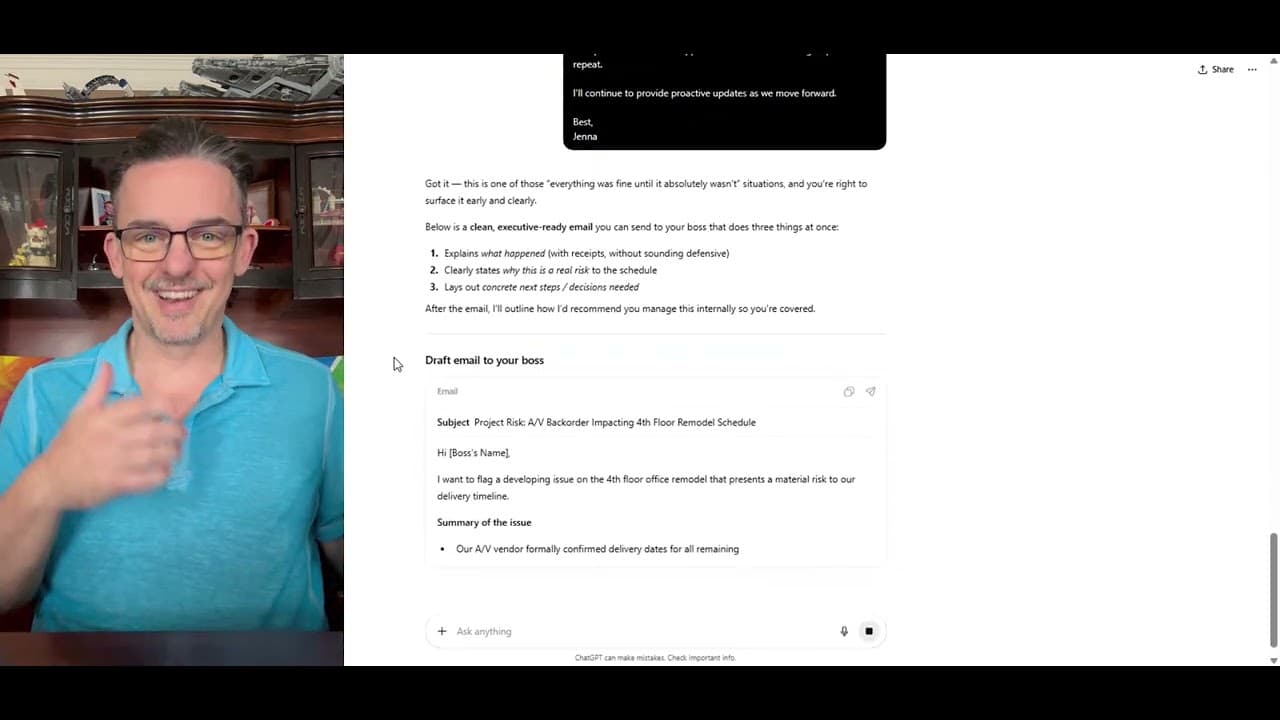
LLM Basics
Introduces the core concepts behind large language models and establishes a practical foundation for understanding how they work.

Why AI Sounds Smart Without Actually Thinking
AI does not think or understand. It predicts tokens based on patterns and context. Confusing fluency with understanding leads to misplaced trust. Effective use comes from supplying the right context, not expecting knowledge.

How AI Actually Works
AI doesn’t think; it predicts. This video breaks down how large language models generate responses and why understanding this helps explain both their power and their failures.
Replacing the idea of AI as magic with a practical mental model makes its strengths and limitations much easier to understand.
What is a large language model, and what does next-token prediction mean?
A large language model (LLM) is an AI system trained to recognize statistical relationships in large amounts of text. It generates a response one token at a time, with each prediction shaped by the prompt, prior conversation, and other context available to it.
Calling this next-token prediction describes the mechanism but not the full behavior that emerges from it. Across many predictions, a model can explain concepts, compare ideas, write software, and adapt its response to a task. It is generating an answer from learned patterns, however, rather than retrieving a prewritten response or consulting a database by default.
Why can AI sound intelligent without thinking like a person?
People naturally associate articulate language with intelligence. A language model has learned patterns connecting words, concepts, explanations, and forms of reasoning, so it can produce communication that appears thoughtful and informed.
Fluent communication does not establish that the model has human experience, intentions, or accountability for consequences. The distinction matters because a convincing explanation may still be incomplete or wrong.
Why can AI be confidently wrong?
Language models aren’t designed to determine whether information is true. They’re designed to generate responses that fit the patterns they’ve learned. Most of the time, those patterns produce accurate information. Occasionally they don’t.
Because AI generates language fluently regardless of whether every detail is correct, incorrect answers can sound just as confident as accurate ones. That’s why verification remains important whenever accuracy has meaningful consequences. AI is an excellent collaborator, but it shouldn’t be treated as an unquestionable authority.

Context Is Everything
AI can only respond to the context available in the current interaction, so relevant, well-structured information usually matters more than finding a perfect prompt.
Building context does not simply mean adding more text. It means supplying the right constraints, examples, goals, and background; continuing a useful conversation; and refining the result through deliberate iteration.

Why Bigger Context Windows Eventually Break Down
Larger context windows help but introduce noise. As more text competes for attention, relevance blurs and outputs degrade. Effective use depends on selectivity, ranking, and compression, not dumping everything into the model.

Iteration Builds Reliable Results by Expanding Context
Professionals iterate with AI to expand and sharpen the context window. Each round adds corrections, examples, and missing data, improving signal and accuracy. Structured iteration treats the context like an evolving brief for reliable outcomes.

You Are Building a Context Window When You Talk to AI
Talking to AI is about managing a context window, not conversing with a mind. What the model sees defines what it can produce. Deliberate iteration and supplying real information improve accuracy and reliability.
Successful AI users spend less time searching for the perfect prompt and more time building better context.
How should context develop as I iterate with AI?
Each useful exchange can clarify the goal, terminology, constraints, examples, and prior decisions that should shape the next response. Review the result, identify a specific weakness or missing assumption, and add information that helps correct it.
A longer conversation is not automatically a better one. Irrelevant or conflicting history can reduce quality. Iteration works best when each turn improves the relevance and clarity of the context rather than merely increasing its length.
Should I start a new conversation or continue an existing one?
It depends on whether the previous context is still helpful. If you’re continuing the same project, keeping the conversation together usually produces better results because the model already understands the background.
If you’re switching to an unrelated topic, starting a new conversation often improves quality by removing irrelevant context. The goal isn’t simply to maximize context—it’s to maximize relevant context.
Why doesn’t adding more information always improve results?
More information isn’t always better information. Large context windows make it possible to provide far more background than ever before, but irrelevant, outdated, or conflicting information can make it harder for the model to identify what actually matters.
Good context is organized, purposeful, and directly related to the task. The most effective AI users don’t simply provide more information—they provide the right information.
Learning to Work with AI
Getting better results from AI depends less on memorizing prompts and more on developing habits of experimentation, iteration, evaluation, and purposeful collaboration.
AI is not a search engine that gives one final answer. It becomes more useful when you use conversation to explore ideas, challenge assumptions, add missing context, and gradually improve a solution. Curiosity and consistent practice matter more than technical credentials.

The AI Mistake That Makes People Feel Dumb
Treating AI like a search engine produces shallow first answers. Iteration adds context, exposes gaps, and turns an initial response into useful work.

Why Some People Learn AI Faster
People who learn AI faster are usually more willing to experiment, revise, and keep going after a weak first result, not inherently smarter.

The Simplest AI Habit That Changes Everything
Clarifying intent before prompting improves the frame for every AI interaction. Name what you are trying to accomplish before asking the model to produce anything.
Becoming effective with AI is less about memorizing techniques and more about developing better working habits.
What is an effective way to learn to work with AI?
Choose a real, low-risk task and use AI throughout the work rather than practicing only with artificial prompts. Compare approaches, ask follow-up questions, inspect weak responses, and notice which context or feedback materially improves the result.
Over time, this develops practical intuition for framing work, providing relevant context, recognizing weaknesses, and deciding when AI is or is not useful. Regular reflection matters more than memorizing prompt formulas.
Should I use AI like Google?
AI and search engines solve different problems. Search helps you find existing information. AI helps you interpret, organize, compare, explain, brainstorm, and build upon information.
Many people become frustrated because they ask AI a single question expecting a perfect answer. AI becomes dramatically more useful when you use it as part of an ongoing conversation that gradually improves the result.
What is prompt engineering really about?
Prompt engineering is less about finding a magical phrase than designing a clear process for the model to follow. Useful prompts provide relevant context, define the task and constraints, identify mistakes to avoid, and describe how the result should be evaluated.
Iteration matters too. Review the response, correct missing or misleading context, clarify the objective, and ask the model to improve specific weaknesses. The durable skill is not memorizing prompt formulas; it is knowing what you are trying to accomplish and how to recognize a good result.
How do I know whether AI gave me a good answer?
Start by checking whether the answer addresses the task, makes its assumptions visible, and distinguishes established facts from claims or inference. When an answer depends on external information, look for traceable sources and determine whether multiple sources are genuinely independent or simply repeat the same underlying account.
A strong answer should also identify important uncertainty and explain what evidence could change its conclusion. The amount of verification should match the consequences: a low-risk draft may need a quick review, while important decisions, technical work, financial guidance, or medical information require reliable sources and appropriate expert scrutiny.
Using AI Responsibly
Responsible AI use means matching the tool to the information and task, protecting sensitive data, verifying important outputs, and keeping people accountable for consequential decisions.
Privacy policies, security controls, data retention, and intended use differ across products and organizational environments. Caution should be proportional to the sensitivity and consequences of the work—not a reason to avoid useful technology altogether.

Why Most Professionals Feel Behind on AI
Why rapid AI adoption makes capable professionals feel behind, how established work habits create friction, and why regular practice matters more than following every new tool.

The Biggest Reason People Avoid AI Isn’t Complexity—It’s Privacy
How information shared with AI may be handled, which choices can reduce exposure, and how to build capability without dismissing legitimate privacy concerns.
Responsible adoption means understanding where AI creates value, where caution is appropriate, and how to use it with confidence.
Is it safe to put company information into AI?
That depends entirely on the tool you’re using and your organization’s policies. Different AI platforms have different privacy practices, data retention policies, and enterprise security features. Some are specifically designed for confidential business use. Others are intended primarily for public information.
Before sharing sensitive data, understand how the service handles your information and follow your organization’s security guidelines.
The Fundamentals Endure
Modern AI is easier to understand than it first appears. The underlying technology is sophisticated, but the principles that make someone effective with it are surprisingly straightforward.
Understand how language models generate responses. Provide better context. Iterate instead of expecting perfection on the first attempt. Develop habits that improve results over time, and use AI with an awareness of both its capabilities and limitations.
The tools will continue to evolve, but an accurate mental model will remain useful across every generation of AI.
Evidence base
Evidence behind the fundamentals
Vaswani et al. · 2017
Attention Is All You Need
The foundational paper that introduced the Transformer architecture behind modern language models.
Brown et al. · 2020
Language Models are Few-Shot Learners
Research showing how model scale and in-context examples produce broad language capabilities.
Liu et al. · 2024
Lost in the Middle: How Language Models Use Long Contexts
Evidence that access to a large context window does not guarantee reliable use of every piece of information within it.
National Institute of Standards and Technology · 2024
AI Risk Management Framework: Generative AI Profile
A cross-sector framework for identifying and managing risks specific to generative AI.
Brown and coauthors · 2020
Language Models Are Few-Shot Learners
The original GPT-3 paper describing autoregressive token prediction and in-context learning at scale.
OpenAI · 2025
Why Language Models Hallucinate
A technical explanation of why language models can produce plausible but false statements.
Joren and coauthors · 2025
Sufficient Context: A New Lens on Retrieval Augmented Generation Systems
Research distinguishing relevant context from context that contains enough information to answer a query, and separating retrieval failures from model-use failures.
OpenAI · 2026
Enterprise Privacy at OpenAI
Official documentation describing enterprise data controls and training policies.
Anthropic · 2026
API Data Usage and Retention
Official documentation describing API retention and related data-handling controls.
Google · 2026
Gemini for Google Workspace Privacy and Security
Official documentation describing privacy protections for business Workspace use.
Continue exploring
AI changes more than tools
Once you understand the underlying system, explore how the same capabilities are changing careers, organizations, leadership, and the skills that create value.
Explore AI and Work