
AI Search and GEO
Search Is Becoming AI’s Knowledge Layer
Search is no longer just about finding links. AI systems increasingly retrieve information, synthesize it, and generate answers before people ever visit a website.
Organizations now compete to become trusted sources that AI systems choose to reference. This guide explains retrieval, AI-ready websites, GEO, and why influence is becoming harder to measure.
Start with the shift in searchA practical starting point
Who this search guide is for
- Marketing and communications leaders adapting to AI-mediated discovery.
- Website teams improving how information is structured and retrieved.
- Organizations measuring visibility beyond clicks and rankings.
- Anyone trying to understand generative engine optimization.
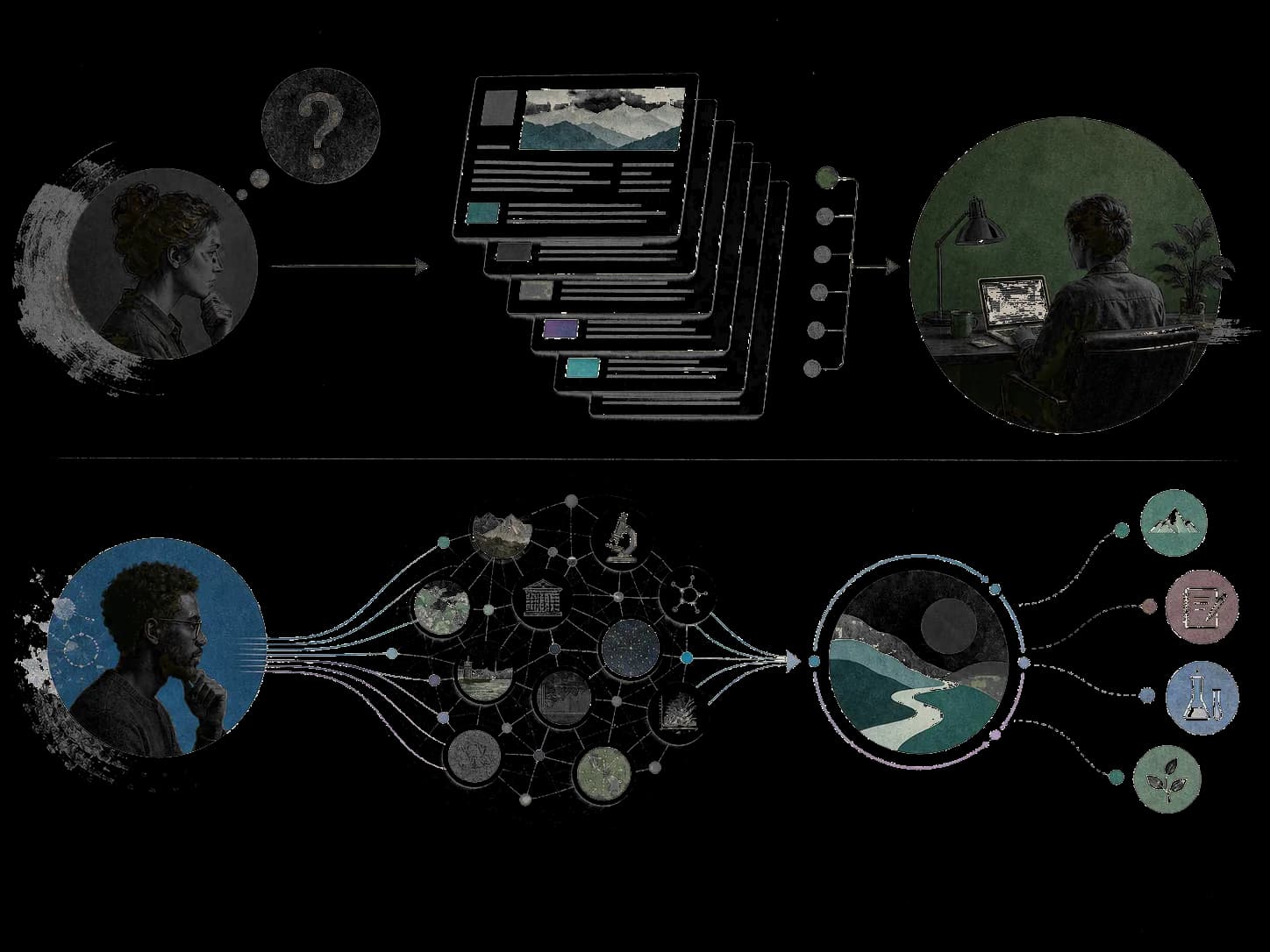
Search Is Changing
AI search does more than rank webpages. It retrieves information from many sources, synthesizes it, and often delivers an answer before a person visits a website.
Discoverability now depends on whether an AI system can find, understand, and confidently use your content—not only where a page ranks. Organizations are increasingly competing to become reliable sources of knowledge.

Retrieval Determines Visibility in AI Search
In AI search, visibility is determined before generation. Modern systems retrieve and ground answers in source content, making retrievability, structure, and semantic precision decisive. This shift requires a content architecture rethink, not just SEO tweaks.

Specificity Now Determines Visibility in AI Search
Broad positioning is breaking down as AI mediated discovery favors highly specific, constraint driven queries. Vague content is no longer retrieved. In this new model, specificity determines visibility, yet many companies still write as if it is twenty fifteen.

From Ranking to Retrieval in AI Search
Search engines are shifting from ranking links to composing answers. Visibility now depends on being retrievable and citeable within AI generated responses, not just ranking first. This fundamentally changes how organizations must approach content strategy.
Visibility is shifting from winning a position on a results page to becoming part of the answer.
What is retrieval?
Retrieval is the process of identifying relevant information before an AI generates its response. Rather than relying only on what was learned during training, many modern AI systems retrieve current or authoritative information from external sources and use it as additional context. Relevance alone is not enough: the retrieved material must collectively contain sufficient information to support the answer. Even then, the model may not use that information reliably, so retrieval quality and generation quality need to be evaluated separately.
Do rankings still matter?
Yes, but rankings are no longer the entire story. Traditional search engines still send visitors to websites, making SEO an important part of digital strategy. However, AI increasingly answers questions without requiring users to visit individual pages. Organizations now need to think beyond ranking highly and focus on becoming authoritative sources that AI systems consistently choose to reference.
What makes information easier for AI search systems to retrieve and use?
Useful information is directly relevant to the question, specific enough to resolve it, clearly organized, current, and consistent with the rest of the site. Descriptive headings, stable terminology, internal links, and explicit evidence can help systems interpret the information and its relationship to other material.
No single quality guarantees selection or citation. AI search products use different retrieval and ranking systems, and those systems change. The durable objective is to publish information that people and machines can understand, verify, and use confidently.
Websites Become Knowledge Bases
AI systems interact with websites as repositories of facts, relationships, and reusable explanations—not simply as pages designed for human navigation.
That makes clear organization, factual consistency, semantic structure, and information architecture more important. The best websites serve human readers while also making organizational knowledge easy for machines to retrieve and interpret.

Structuring Website Content for AI Consumption
AI systems consume website content as fragments rather than complete pages. Teams need consistently defined, scoped, and described concepts across their sites so information can be accurately recombined without losing meaning.

AI Changes Content Accuracy Before Search Performance
AI usually affects how a business is interpreted before it affects traffic or rankings. Incomplete or inconsistent content gets recombined into plausible but inaccurate explanations, reducing control over how the business is described by AI systems.

Organizing Website Content for AI and Human Readers
As AI systems extract snippets rather than read pages, content organization becomes a visibility strategy. Clear structure, explicit answers, and machine readable formatting help AI interpret expertise while still serving human users.
In an AI-first web, information architecture becomes as important as content creation.
Why is content accuracy becoming so important?
AI systems often combine information from multiple sources when generating answers. Inaccurate, outdated, or inconsistent information reduces confidence and makes it harder for AI to rely on a website as an authoritative reference. Organizations that consistently maintain accurate content become more trustworthy both to people and to AI systems retrieving information on their behalf.
What makes a website’s information AI-ready?
AI-ready information is accurate, current, specific, and organized around concepts people actually need to understand. Clear page titles, semantic headings, consistent terminology, meaningful internal links, and maintained source information make relationships easier to retrieve and interpret.
This is not a separate style of writing for machines. It is sound information architecture and useful content for both people and AI systems. Agent-ready services go further by adding the interfaces, identity, permissions, and feedback required for authorized action.
SEO + GEO
Generative Engine Optimization expands traditional SEO by helping AI systems retrieve, interpret, and confidently reference information when generating answers.
SEO still helps search engines understand and rank webpages. GEO adds a second objective: making content precise, structured, credible, and useful inside generated responses. Organizations increasingly need to optimize for both.

SEO, GEO, and Why Declining Traffic Can Be Misleading
Declining traffic does not mean declining influence. As AI systems retrieve and summarize content upstream, SEO determines discoverability and GEO shapes representation, making websites harder to measure but more critical as sources of truth.

How AI Uses Web Content and Why Analytics Feel Broken
AI systems increasingly consume and summarize web content without direct visits, turning websites into sources of truth for other systems. This shift weakens traditional analytics and attribution while raising the bar for clarity, structure, and authority.
GEO does not replace SEO. It extends optimization from rankings into generated answers.
How do SEO and GEO complement each other?
Search engine optimization (SEO) helps search engines crawl, understand, and rank content for traditional results. Generative engine optimization (GEO) considers whether AI systems can retrieve, interpret, and reference that information while producing answers.
They share durable foundations: useful content, technical quality, clear organization, authority, and accurate information. GEO expands the discovery problem; it does not make traditional search or SEO obsolete.
How should organizations prepare for AI search?
Start by creating genuinely useful content. Organize information logically, maintain accuracy, answer important customer questions comprehensively, strengthen technical SEO, and build long-term authority in your subject area. Organizations that consistently produce trustworthy information are well positioned regardless of how search interfaces continue evolving.
Analytics & Influence
AI can shape research and decisions without sending a visitor to the source, making clicks and page views a less complete measure of digital performance.
Organizations may influence a customer long before a trackable website session. Brand recognition, citations, assisted conversions, AI visibility, and business outcomes now belong alongside conventional traffic metrics.

The Invisible Influence Layer of AI
AI now mediates research and evaluation, shaping buying decisions without generating site visits. As content influences choices through summarized answers, traditional attribution models fail to capture this invisible layer of impact.

Why Traditional Analytics Break Down in an AI-Mediated World
As AI mediates research and decision making, traditional analytics capture less of the real influence of content. Measurement models built on visits and funnels miss upstream impact, requiring new ways to assess visibility, accuracy, and decision shaping.
When AI mediates discovery, influence can rise even while direct traffic falls.
Why can a website’s influence increase without a corresponding increase in traffic?
AI systems can synthesize information directly in search results or assistants. A person may learn about an organization, include it in a decision, or contact it later without visiting the page that helped inform the answer. In that case, the content may have contributed influence without producing a conventional session or click.
That influence is difficult to attribute precisely. Traffic analytics remain useful, but they capture only the interactions that reach the website and should be interpreted alongside broader discovery and business outcomes.
How should organizations measure AI-search visibility and influence?
Combine traditional measures such as search visibility, qualified traffic, engagement, leads, and conversions with broader indicators such as branded search, direct visits, customer-reported discovery paths, and AI citations where they can be measured responsibly.
Separate observable indicators from inferred influence. Citation frequency or an AI referral can provide evidence of visibility, but neither proves a business outcome by itself. The most useful measurement connects discovery signals with customer quality and organizational results.
Become a Source AI Can Trust
The future of search belongs to organizations that produce accurate information, structure it well, and make it easy to retrieve.
Attracting visitors still matters, but it is no longer the only goal. Build a website that functions as a credible knowledge source, and evaluate success by influence and business outcomes as well as traffic.
In AI search, the most useful source often matters more than the loudest page.
Evidence base
Search and GEO evidence
Google Search Central · 2026
AI Features and Your Website
Official guidance on eligibility, content, internal links, and structured data for Google AI search features.
Microsoft Bing · 2026
AI Performance in Bing Webmaster Tools
How Bing measures citations, grounding queries, and page-level visibility in AI-generated answers.
Google Search Central · 2026
Creating Helpful, Reliable, People-First Content
A framework for useful, original, trustworthy content grounded in clear authorship and expertise.
Joren and coauthors · 2025
Sufficient Context: A New Lens on Retrieval Augmented Generation Systems
Research distinguishing relevant context from context that contains enough information to answer a query, and separating retrieval failures from model-use failures.
Google Search Central · 2026
Understand How Structured Data Works
Official guidance explaining how structured data provides explicit clues about a page's meaning.
Continue exploring
Protect judgment in an AI-mediated world
Explore how AI affects reasoning, learning, trust, and the human responsibility to decide what deserves belief and action.
Explore AI and Thinking