Video library
AI Fundamentals Videos
Clear explanations of language models, context, iteration, hallucinations, privacy, and responsible everyday use.
Browse the library
14 videos
 Watch video
March 26, 2025
AI Output Quality Depends on Context Systems
AI performance depends on the quality of context provided. Organizations with clean data, strong memory, and effective retrieval produce better results, while weak or fragmented context leads to coherent but flawed outputs. Competitive advantage comes from managing context well.
Read transcript for “AI Output Quality Depends on Context Systems”
Lightly edited for clarity.
The quality of what AI gives you is only as good as the context you provide, and organizations differ wildly in how well they manage context.
Again, AI doesn’t think. It generates tokens based on the context you give it. And if that context is weak, scattered, conflicting, incomplete, AI will fill in the gaps coherently, but not necessarily correctly.
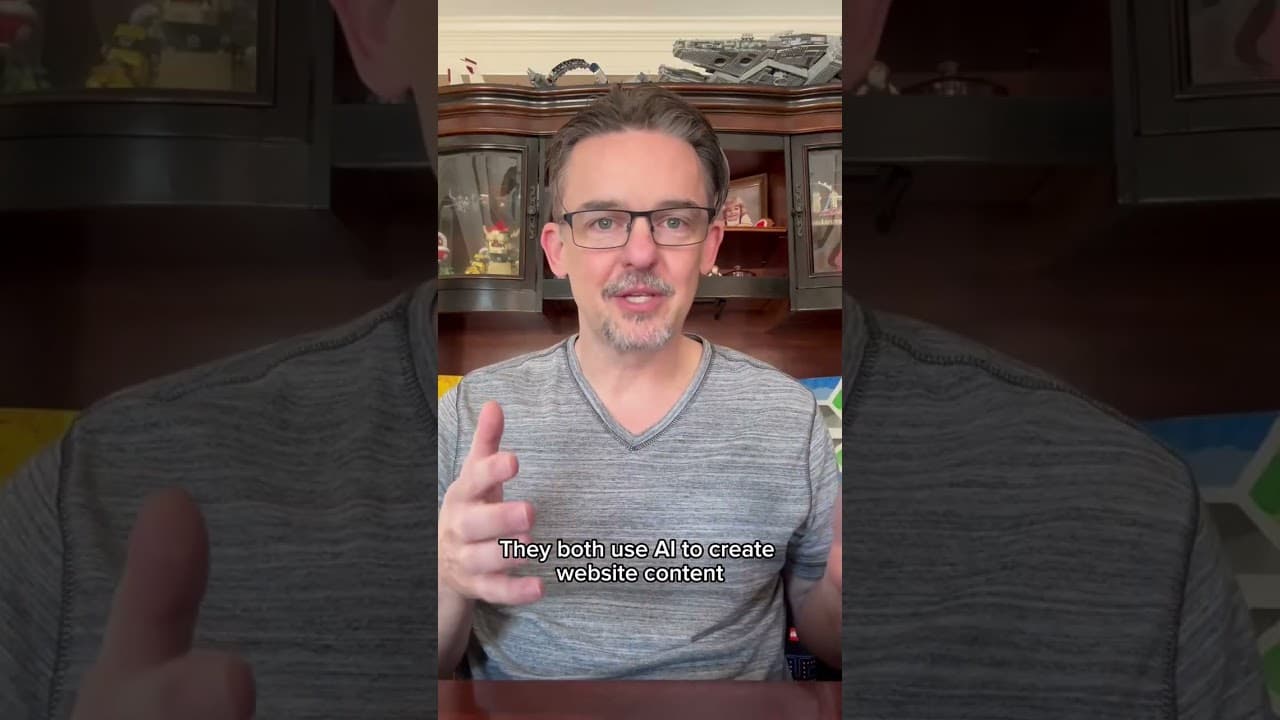
So let’s say you’ve got two marketing teams. They both use AI to create website content, email campaigns, social media posts. One has rich, clean customer data and detailed campaign history, the other’s missing half of it, and it’s clear who wins in that scenario.
It’s not about the tools, it’s about organizing and managing that context effectively.
Garbage in, garbage out has been a core concept in software since there has been software. AI doesn’t change that.
The competitive edge isn’t just who has AI, it’s who builds better context systems, better memory, better retrieval, better data quality.
 Watch video
December 2, 2025
AI Makes You Smarter
AI doesn’t replace thinking; it expands it. This video shows how AI improves decision quality, planning, and awareness by helping you consider options and pitfalls you might otherwise miss.
Read transcript for “AI Makes You Smarter”
Lightly edited for clarity.
AI makes you smarter, not in theory, but in the way you actually work.
And when I say that, I don't mean it improves your IQ, but it improves the quality of your decisions, your clarity, your options, and how deeply you think through a problem.
There's a quick example.
Let's say you're a front end developer. You know HTML, CSS, and React. You get put on a new project to build a public website based on Optimizely. Since you don't know Optimizely, traditionally you'd spend some time on Google. You'd read some blogs, maybe watch a few videos, read through the documentation, generally figure out what you need to do and how to approach it, and get started coding.
With AI, you have different options. You can use it to plan what you're actually gonna do. So you can ask it questions like: what's the best architecture for this? What are the new React features I should be using? What pitfalls do people usually run into, enough to optimize the implementation?
And even more critically, what can I automate? What can I use AI to do? How can I do this faster than I did in the past?
And it walks you through the things that you would think about, and fills in the details and answers questions, but it also points out things that you wouldn't think about.
You still have to bring your own judgment, but AI expands the surface area of your thinking.
So that's what I mean when I say AI makes you smarter. It doesn't replace you, but it does extend you.
 Watch video
December 3, 2025
The Biggest Reason People Avoid AI Isn’t Complexity—It’s Privacy
How information shared with AI may be handled, which choices can reduce exposure, and how to build capability without dismissing legitimate privacy concerns.
Read transcript for “The Biggest Reason People Avoid AI Isn’t Complexity—It’s Privacy”
Lightly edited for clarity.
The biggest reason I see people not using AI is privacy concerns. And honestly, that's very reasonable.
By default, most AI tools log your conversations. They store what you type. Many of them are using your conversations to train future versions of those models. That's how the defaults work.
The good news, though, is that you have options. You can turn on no training or zero retention modes. You can use enterprise accounts that don't train on your data. Or, if it's very private, you can run a local LLM, and none of the information ever leaves your device.
I'll be covering all this in follow-up videos. So I'll go through which tools truly honor zero retention, the settings that most people don't change and should, how enterprise versus consumer privacy differs, and when you should be using local models. And I'll go through that provider by provider and cover OpenAI, Microsoft, Google, etcetera.
Here's the key, though: you need to decide for yourself what you're comfortable sharing.
And I'd recommend you start with low risk tasks. So use AI for planning, for brainstorming, for cleaning up your documentation. And then as you see the value that provides, and your comfort level increases, and your knowledge of privacy increases, then you can use it more and more.
Once you understand privacy and how it affects what you do, what you type, which types of models you use, it really unlocks the capabilities of AI and allows you to use it confidently instead of cautiously.
 Watch video
December 4, 2025
What Are Your Goals? Do You Have a Plan?
AI can be used as a planning partner for nearly any goal, from career growth to financial independence. This video shows how providing the right context turns vague goals into concrete, step-by-step plans.
Read transcript for “What Are Your Goals? Do You Have a Plan?”
Lightly edited for clarity.
What are your goals in life? What do you wanna do? What do you wanna achieve?
Do you want a promotion? Well, do you have a well structured, detailed, step by step plan for doing that? If the answer is no, let's fix that. We can do it right now.
Explain what you know about the job you want, which is not everything, cause you don't have that job yet. Explain the social dynamics involved, the team members, any financial considerations, any context you have that would affect this outcome.
Give a model that context and then use it to help you define a detailed, step by step plan for achieving that goal.
And the amazing thing here is that it's not just for promotions. It's for literally any feasible goal that anyone has.
You wanna retire early? Give them all the context. How much money you have. Tell it how it's invested. What assets do you have? What debts do you have? How much do you earn? How long are you gonna continue working?
You wanna start a business. You wanna move to Costa Rica. Wanna become a cowboy. It doesn't matter what your goal is or your goals are.
I challenge you, go do it right now. Go give a model context to achieve whatever your goal is. Put together a plan and then start executing that plan.
And by the way, if you get stuck on any step of that plan, you have AI, which is an expert coach in literally everything people do, that can teach you and show you how to do those things, how to accomplish your goals.
This is amazing. This is a game changer. I can't believe more people don't use AI in this way.
So whatever it is your goals in life are, go put a plan together and then let's get started.
 Watch video
December 9, 2025
Why Most Professionals Feel Behind on AI
Why rapid AI adoption makes capable professionals feel behind, how established work habits create friction, and why regular practice matters more than following every new tool.
Read transcript for “Why Most Professionals Feel Behind on AI”
Lightly edited for clarity.
If you feel behind on AI, there's nothing wrong with you. Your habits came from a different world.
Most of us built our work habits in a pre AI environment. So especially if you're my age, you remember when home computers were new. You remember when the internet was new, then when mobile was new, then when remote work was new. And each one took years for people to fully adjust to.
But AI didn't give us years. It arrived very quickly, and it changed expectations even faster.
It's a lot like the shift to working from home during COVID. The technology was already there—Zoom, cloud files, messaging tools—but our habits were built around offices, commutes, and in person everything.
So the technology changed overnight, and the habits took time to catch up.
AI is the same dynamic, but it's on a much faster timeline. The tools moved ahead instantly, and our habits are still catching up. And that's okay.
Once you build a couple of simple habits—clarifying what you want, asking clean questions, iterating instead of judging the first answer—everything gets easier.
You're not behind. Your habits are from a world that didn't have AI built-in, and habits can change quickly.
 Watch video
December 12, 2025
The Simplest AI Habit That Changes Everything
Clarifying intent before prompting improves the frame for every AI interaction. Name what you are trying to accomplish before asking the model to produce anything.
Read transcript for “The Simplest AI Habit That Changes Everything”
Lightly edited for clarity.
If you only build one AI habit, this is the one. It makes every prompt, every workflow, every output instantly better.
Most people jump straight into asking AI for something, and then wonder why the response is vague or off target.
The fix is simple. Take the time before you ask to clarify your intent. It doesn't necessarily need to be a long explanation, but at least a sentence of what am I actually trying to do here.
What is my goal?
Am I trying to summarize, rewrite, brainstorm, explain, compare options, make a decision, create a plan?
Once you name the intent, everything gets easier. Your prompts get clearer, your answers get better, you spend less time fixing things and more time applying them.
AI doesn't need complexity. It needs clarity. And clarity starts with that pause.
Most people don't struggle with AI. Most people struggle with AI because they skip this step. Clarity in, clarity out.
 Watch video
December 15, 2025
How AI Actually Works
AI doesn’t think; it predicts. This video breaks down how large language models generate responses and why understanding this helps explain both their power and their failures.
Read transcript for “How AI Actually Works”
Lightly edited for clarity.
AI doesn't think, but it is really good at guessing the next thing to say.
When people talk about AI, usually what they're talking about is large language models, or LLMs.
Now, LLMs operate on tokens. Tokens and words are not the same thing, but it is really helpful to think of them as the same thing to understand the concept.
So in language, words have relationships to each other. When I say, “uh oh, sounds like somebody has a case of the Mondays,” every word connects. “Uh oh” relates to what follows. It signals that something bad is coming. “Case” relates to “Mondays.” And together they form a phrase.
And even if you've never heard that phrase, you can tell from context it's not good.
LLMs are mathematical models that learn those relationships, not as rules, but as probabilities. When we train a model, we give it a bunch of examples of language. Training teaches it to map which words are likely to come next, based on all the words that came before.
So in that example, “uh oh, sounds like somebody's got a case of the blank,” it might predict Mondays, or it might predict flu. And it really depends on if you were talking about Office Space, or you were talking about the fever that you have.
When AI is responding to you, what it's really doing is predicting the next word, one at a time, based on all the words that came before it in the conversation. And then it predicts the next one, and the next one, and so on.
And that's why it can sound so confident while being completely wrong. It doesn't know. It just guesses well, based on context.
This is the fundamental concept for using AI. Once you understand this, all the weird behaviors start to make a lot more sense.
 Watch video
December 17, 2025
Why Some People Learn AI Faster
People who learn AI faster are usually more willing to experiment, revise, and keep going after a weak first result, not inherently smarter.
Read transcript for “Why Some People Learn AI Faster”
Lightly edited for clarity.
Some people seem to learn AI very quickly, and it's not necessarily because they're smarter. It's because they're comfortable with one specific thing.
The people who pick up AI fastest aren't always the ones with technical backgrounds. They're the ones who are comfortable with iteration.
So most of us were trained to get things right on the first try. School rewards the correct answer. Work rewards polish. AI rewards the opposite.
AI works best when you try something, see what happens, adjust, refine, and repeat. It's a collaboration. It's not a test.
The people who struggle with AI usually expect perfect output immediately. When they don't get it, they assume, well, AI is not good at this.
The people who thrive treat the first output as a starting point, and they shape it. They ask follow ups. They give context. They clarify the goal. They correct misunderstandings. They iterate.
AI isn't about knowing. It's about exploring.
So if you can build the habit of iteration, you'll learn AI faster than almost anyone, because you're working with the tool instead of judging it.
 Watch video
December 23, 2025
The AI Mistake That Makes People Feel Dumb
Treating AI like a search engine produces shallow first answers. Iteration adds context, exposes gaps, and turns an initial response into useful work.
Read transcript for “The AI Mistake That Makes People Feel Dumb”
Lightly edited for clarity.
There's one AI mistake that instantly makes people feel like they don't get it, and it is avoidable.
Most people treat AI like a search engine. That makes sense. We've all been using search engines for a long time. They ask once, and if the answer isn't great, they stop.
They think, I must be doing this wrong. Maybe AI isn't for me, or this tool isn't good.
But AI is not a database. It's a collaborator. And the first answer is almost never the best answer. It's the starting point.
The real power comes from the next question. Refine this. Push this further. Explain the trade offs. Rewrite it at a higher level. What am I missing? Give me three alternatives. Simplify this.
When you treat AI as iterative, you stop feeling inadequate and you start feeling capable.
The mistake isn't getting a mediocre first answer. The mistake is stopping there.
 Watch video
January 27, 2026
Why AI Sounds Smart Without Actually Thinking
AI does not think or understand. It predicts tokens based on patterns and context. Confusing fluency with understanding leads to misplaced trust. Effective use comes from supplying the right context, not expecting knowledge.
Read transcript for “Why AI Sounds Smart Without Actually Thinking”
Lightly edited for clarity.
Most people still think that AI is thinking. It isn’t. A large language model doesn’t reason or understand. It predicts one token at a time. Each word you see is the next most probable continuation of the last one, based on patterns it learned from billions of examples.
When you type a prompt, the model converts everything into tokens, fragments of words, punctuation, or symbols. Then, starting from the first one, it predicts what should come next. Every token it generates becomes new context, more data it can use to predict the following one.
And that difference matters, because misunderstanding it leads to misplaced trust. This is why AI can produce fluent, convincing, even insightful responses and still be completely wrong. It’s coherent, not conscious.
This is where context comes in. The model’s reasoning is defined entirely by what’s inside its context window. If the information isn’t in that window, it doesn’t exist to the model. Understanding this changes how you work with AI. Stop expecting it to know things and start focusing on feeding it the right context.
That’s not prompt engineering. That’s context engineering. In the next video, we’ll look at what a context window is, the space the model works inside when it predicts.
 Watch video
January 28, 2026
You Are Building a Context Window When You Talk to AI
Talking to AI is about managing a context window, not conversing with a mind. What the model sees defines what it can produce. Deliberate iteration and supplying real information improve accuracy and reliability.
Read transcript for “You Are Building a Context Window When You Talk to AI”
Lightly edited for clarity.
When you talk to an AI, you’re not chatting with a mind. You’re building a context window, the block of text the model uses to decide what to generate next.
Every prompt you write, and every response the model gives, gets packed into that window. All of it’s converted into tokens, fragments of words or symbols, and sent back in with each new request. That combined text is the full input the model can reference when it predicts the next tokens.
If something’s not in that context window, it doesn’t exist to the model. There’s no long term memory, no hidden look up, unless another system adds information into the window. For it, it’s like giving a teammate a single page of notes and asking for feedback. They can only respond to what’s on the page.
If key details are missing, they’ll fill the gaps with guesses. Iteration is how you correct that, by expanding and refining what’s inside the window until the model has enough context to stay accurate.
Ask summarize our marketing plan without including the plan, and the model will invent one. Include the actual plan or have a retrieval system insert it, and now it sits inside the context window. The output becomes specific and grounded instead of generic.
The context window defines what the model can work with. Manage that window deliberately, and you control both quality and reliability. In the next video, we’ll see how iteration strengthens that context window and why every round of refinement matters.
 Watch video
January 29, 2026
Iteration Builds Reliable Results by Expanding Context
Professionals iterate with AI to expand and sharpen the context window. Each round adds corrections, examples, and missing data, improving signal and accuracy. Structured iteration treats the context like an evolving brief for reliable outcomes.
Read transcript for “Iteration Builds Reliable Results by Expanding Context”
Lightly edited for clarity.
Most people stop after one prompt. Professionals don’t. They iterate, because every exchange expands and sharpens the context window the model is working inside.
Each time you send a new prompt, the model sees everything so far, your messages and its own previous replies, and that full text becomes the new input, block the current context window.
When you add corrections, examples, or clarifications, you’re not just fixing wording, you’re feeding the model better data to pattern match against. Iteration isn’t polishing style, it’s improving signal.
Say you ask for a summary of a long report, and the first output misses some key points. You highlight what’s wrong, paste the missing sections, and ask it to adjust. Now those corrections sit inside the context window. The model’s next prediction uses both the original text and your feedback, usually producing a far stronger result.
And that loop, prompt, response, correction, is how you build accuracy. Strong iteration has structure. Each round should add new information, not just try again. Point out what’s inaccurate, add missing data, clarify intent.
You’re treating the context window like an evolving brief, rewriting it, until the model has everything required to predict correctly. Iteration is context management in motion. Every round defines the data surface the model can work with. Do it deliberately and you’ll get high quality, reliable results, not lucky ones.
 Watch video
January 30, 2026
Why Bigger Context Windows Eventually Break Down
Larger context windows help but introduce noise. As more text competes for attention, relevance blurs and outputs degrade. Effective use depends on selectivity, ranking, and compression, not dumping everything into the model.
Read transcript for “Why Bigger Context Windows Eventually Break Down”
Lightly edited for clarity.
Bigger context windows sound like progress, and they are. But there’s a limit. You add too much text, and the model starts to lose clarity instead of gaining it.
The context window is the entire block of text. The model reads at once all your prompts, its previous responses, and any retrieved documents. And as that window grows, the model has to weigh thousands, or even hundreds of thousands of tokens at once. Each token competes for attention, and relevance starts to blur.
In practice, that means longer responses, slower inference, and sometimes worse reasoning beyond a point. Extra text becomes noise. You’ve probably seen this if you’ve been working with AI for a while. In older models, the longer the chat went on, the stranger the answers became. That’s not random. Those systems had smaller windows, so older content was dropped or summarized.
Modern models can handle far more text, but the trade off never disappears. Larger windows reduce memory loss but increase noise sensitivity.
Imagine loading an agent with every document in a department—all the policies, reports, meeting notes, project plans, everything. And when those files overlap or conflict, the model has no built-in way to choose which is correct. The output drifts because conflicting tokens occupy the same context window. Dumping in everything just in case usually backfires.
Effective use of large context windows isn’t about size, it’s about selectivity. Good retrieval pipelines rank, filter, and compress information before it ever enters the model. That keeps the context precise enough for accurate prediction.
Context collapse is a design problem, not a model failure. More text isn’t more intelligence, it’s just more data. Keep the window clean and the model stays coherent. In the next video, we’ll close this series with a practical method for adding structure instead of noise.
 Watch video
February 4, 2026
LLM Basics
Introduces the core concepts behind large language models and establishes a practical foundation for understanding how they work.