Video library
Human Cognition Videos
How AI can expand exploration while cognitive offloading and overreliance risk weakening independent thought and practiced skill.
Browse the library
5 videos
 Watch video
January 16, 2026
AI Expands Exploration, Humans Decide What Matters
AI does not replace thinking, it changes how ideas are explored. Models expand the space of possibilities, but humans must still decide what matters, because fluent output without judgment leads to shallow decisions.
Read transcript for “AI Expands Exploration, Humans Decide What Matters”
Lightly edited for clarity.
People love to ask if AI will replace thinking
It doesn’t replace cognition. It rebalances it. It expands what we can explore, but it can’t decide what’s worth finding. That’s human work.
Humans have a bias toward premature convergence. We reach a plausible answer, feel relief, and stop searching because uncertainty is uncomfortable and closure feels safe.
That tendency shows up everywhere: debugging, design, strategy, leadership. It is efficient, but it often narrows the field too soon.
Language models behave differently. They don’t get tired. They don’t need closure. And they don’t protect their ego.
They can keep generating options, endlessly exploring edge cases, reframing problems, and surfacing perspectives we might have missed.
That makes them excellent divergence engines, tools for exploring the space of possibilities before judgment kicks in.
They do hit technical limits of context windows, compute, and memory, but not psychological ones.
The right division of labor is simple. AI handles divergence, expansion, exploration, and hypothesis generation. Humans handle convergence, prioritization, trade offs, and judgment.
When people invert that and let the model decide while they defer, quality collapses. Fluency replaces understanding, and decisions lose grounding.
LLMs don’t increase intelligence. They extend it. They reduce friction, recall limits, and search time.
Used correctly, they make reasoning broader and faster. Used poorly, they just make mistakes louder.
AI doesn’t think. It performs language based cognitive behaviors without grounding, stakes, or awareness.
Humans think because our mental models are built from consequences and care.
Together, we can build systems where AI extends reach and humans steer direction. That isn’t replacement. It is augmentation.
 Watch video
April 7, 2026
Cognitive Offloading and the Risk to Mental Models
Relying on AI and tools boosts efficiency but can weaken internal understanding over time. The key is not avoiding tools, but continuing to build strong mental models so you can adapt when situations change.
Read transcript for “Cognitive Offloading and the Risk to Mental Models”
Lightly edited for clarity.
I’ve driven from my home to my office countless times, I’m sure most of you have as well, and we’ve all become accustomed to using GPS to get us there, efficiently. But when you turn your GPS off, what happens? You still know how to get to work, right, but you start second guessing specifics like, this is the road I should turn on, right?
It’s called cognitive offloading. The more we rely on external tools, whether it’s GPS or search engines or AI assistance, the less we build our own mental models. We remember how to get to the answer, but not the answer itself. And that’s not necessarily bad. Tools have always done this. Calculators did it for arithmetic, search engines did it for facts.
But AI is different in one very important way. It doesn’t just help you find answers, it helps you produce them. So if you rely on it for analysis, reasoning, or writing, something subtle can happen. Over time, you get faster at producing work, while your mental model gets weaker. You still recognize a good answer when you see one, but starting from a blank page starts to get harder.
And the goal is not to avoid using tools. It’s not to avoid using AI. That’s ridiculous. The goal is to make sure you’re still building your mental model while you use it. Efficiency is great, but when the situation changes, and it always changes, understanding is what gets you to your destination.
 Watch video
April 10, 2026
The Risk of AI Is the Erosion of Human Thinking Skills
AI’s biggest risk is not replacement but cognitive atrophy. As systems handle more work, people may stop practicing core skills, leaving them unprepared when errors matter. Effective design keeps humans actively thinking and engaged.
Read transcript for “The Risk of AI Is the Erosion of Human Thinking Skills”
Lightly edited for clarity.
The real risk of AI is that we stop thinking. And this happens with automation all the time. When a system works most of the time, people naturally stop practicing the underlying skill.
Pilots are a good example. Modern aircraft fly on autopilot most of the time. It’s incredibly safe. It’s incredibly efficient. But because of that, pilots train for the moments when something breaks, bad weather, system failures, situations where they suddenly have to take manual control. Because when those moments happen, they can’t be rusty.
And AI is creating similar dynamics in knowledge work. If the model writes the draft, and it summarizes the research, and it generates the analysis, it’s easy to slide into a role where you’re mostly just approving what the system produces. And that works right up until the moment something important is wrong.
So the goal isn’t to replace people. It’s to design systems that keep them thinking, review processes and decision logs and second opinions. And I like to do regular manual mode, where you work through problems yourself. And not because AI isn’t useful, but because the skill you stop using is the skill you lose. And do you really wanna lose the skill of thinking.
 Watch video
August 17, 2026
Choosing Where Your Time and Attention Go
Every promising conversation can create new possibilities, but pursuing them all comes at a cost. Choosing where to invest time and attention means appreciating some opportunities without turning each one into a commitment.
Read transcript for “Choosing Where Your Time and Attention Go”
Lightly edited for clarity.
My dad tells me, you can do anything you want, but you can’t do everything you want. And I swear I repeat that to myself every day.
Uh man, I’ve had a lot of really good conversations over the past couple weeks, and with really smart, interesting people. And almost every conversation created another possible direction, you know, someone I could introduce, or a project we could explore together, or another conversation we could have, or an idea I’d like to spend more time thinking about. And I genuinely would like to pursue a lot of them.
But every time you say yes to something, you’re deciding where your time and attention go. And if you try to keep every possibility alive, eventually, you make commitments that you can’t give enough attention to.
And sometimes a good conversation can just be a good conversation. You can appreciate the person and stay connected, and leave room for the right reason to work together later.
So yeah, you can do anything you want, but you have to choose because you can’t do everything you want.
 Watch video
August 19, 2026
Choosing the Experiences That Shape Who You Become
Turning 50 brings mistakes, hardships, successes, and growth into focus. The next decade cannot be fully controlled, but choosing and directing meaningful experiences can shape who you become.
Read transcript for “Choosing the Experiences That Shape Who You Become”
Lightly edited for clarity.
It’s my birthday today. I’m 50. And maybe because I’m 50, I was just thinking about life and, you know, what I spent 50 years doing. And when you look at that, it’s really easy to see the mistakes, you know, all the relationship problems that were your fault, and all the times you were mean to somebody that didn’t deserve it, all the times you lied when you should have told the truth, all the decisions that you just didn’t make.
And it’s really easy to see the things that really weren’t your fault too. You know, maybe you trusted somebody that took advantage of you, or, you know, you had an accident or medical problems, or just tough situations that, you know, you just have to deal with. They suck.
And it’s also really easy to see your successes, you know, all the good relationships that you have and the things that you built that you’re proud of and the people you helped. And I look at my life and I see all of that. And it’s a curious thing to realize that all of that is what makes you who you are.
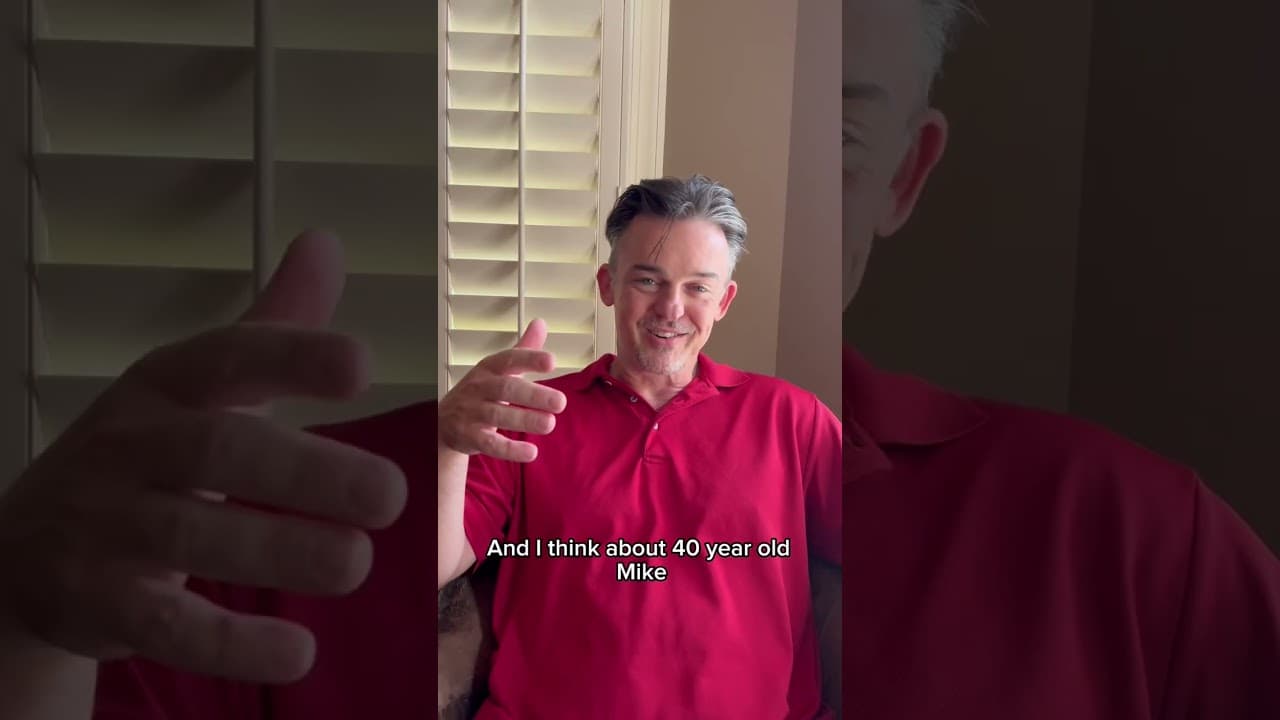
And I think about 40-year-old Mike, and I’m a much different person than I was then, which, of course, I am. I’ve had 10 years of life experience that 40-year-old Mike didn’t have. And it’s important to understand that 10 years from now, you’ll be a much different person too, because you’ll have had 10 years of life experience that you currently don’t have.
But you have the opportunity to have a say in what those life experiences are gonna be. And you can’t control all of them, but you can definitely direct them. You can choose what kind of experiences you wanna have.
And, uh, I’m exhausted. I have so much to do, but I’m excited to do it because I’m choosing to curate the experiences that I think I need to have. And I need to learn from to become the kind of person that I wanna be, to become better and more capable. So I’m gonna go get started.