Video library
Judgment Videos
Why judgment remains a human responsibility, how it develops through practice, and why confidence is not a substitute for it.
Browse the library
5 videos
 Watch video
December 10, 2025
The One Skill AI Cannot Replace: Good Judgment
As AI accelerates execution, judgment becomes more valuable. People still have to choose what matters for a particular situation, team, and moment.
Read transcript for “The One Skill AI Cannot Replace: Good Judgment”
Lightly edited for clarity.
AI can generate a lot of things, but the thing it can't generate is good judgment.
Judgment is the ability to choose between options, to understand what matters, to see context, nuance, timing, and people.
AI can help you brainstorm, summarize, draft, rewrite, but it can't decide what's right for this situation, this team, or this moment.
It can give you material, but you're the one that gives it meaning.
This becomes even more important as AI accelerates the easy parts of work. When everyone can generate content instantly, the value shifts to the people who make sound, thoughtful decisions.
And by the way, judgment isn't fixed. It's a skill you can develop. We'll talk more about how to do that in a future video.
So AI can produce the work, but only you can decide what the right work is. That's judgment, and it gets more valuable as AI gets better.
 Watch video
January 19, 2026
AI Accelerates Execution but Not Human Judgment
AI systems speed up execution by drafting and organizing, but they do not possess judgment. Judgment comes from human experience, interpretation, and consequence. Used correctly, AI amplifies human thinking rather than replacing it.
Read transcript for “AI Accelerates Execution but Not Human Judgment”
Lightly edited for clarity.
AI accelerates execution, but execution is not judgment. Large language models don’t understand. They predict, generate, and summarize by mapping statistical patterns between words. They connect tokens, not meaning.
Humans connect language to experience, emotion, memory, and consequence. We don’t just recognize patterns; we interpret them. We weigh tradeoffs, recall outcomes, and imagine futures. That’s judgment: reasoning rooted in lived experience.
As models grow, they’ll coordinate more steps and hold more context, but the mechanism stays the same: correlation, not comprehension.
The goal is not to offload judgment. It’s to amplify it. Let AI handle the execution layer: drafting, summarizing, translating, organizing, so you can design and reason and decide with greater clarity.
AI accelerates execution, not judgment. It makes your thinking more valuable, not less.
 Watch video
March 27, 2026
Attention and Judgment Define Value in the AI Era
AI creates abundant insights, but attention and judgment determine value. Without systems to filter and prioritize, output becomes noise. Success depends on deciding what matters and acting on the highest-impact opportunities.
Read transcript for “Attention and Judgment Define Value in the AI Era”
Lightly edited for clarity.
When information is everywhere, attention limits what you can actually act on.
AI generates endless insights. It’s a divergence engine. But while you can do anything you want, you can’t do everything you want, and without a system to filter and prioritize and route information, you get noise, not clarity.
So if you’re responsible for a brand or a website, hopefully you’ve started looking at GEO analytics. And if you haven’t or you don’t know how, I have a whole team of people that would love to talk to you about it.
So you looked at your analytics, you used AI to analyze it, and it surfaces 50 different opportunities for personalized content, different industries, different intents, different customer journeys. Could you build all of them? Probably. Should you?
Winning isn’t just about producing more, it’s about deciding what actually deserves your attention.
And when people say judgment is a key human skill in the age of AI, that’s what they mean.
 Watch video
April 3, 2026
Why AI Confidence Should Not Replace Human Judgment
AI tools can sound authoritative, but coherence is not accuracy. The real advantage is not having access to AI, but building the discipline to question its outputs before acting on them in business-critical decisions.
Read transcript for “Why AI Confidence Should Not Replace Human Judgment”
Lightly edited for clarity.
We’ve all built a habit that when a computer says something, we think it must be right. I made an appointment. Well, it’s not in the system. I sent an email. Well, clearly you didn’t, because I didn’t get it. This program produced this report, so it’s right.
And the more advanced the system looks, the more likely we are to just follow along. We see it all the time. People will follow their GPS even when it’s clearly wrong. And in business it’s the same deal. When an AI recommendation comes in, we’re more likely to go with it, especially because it’s coherent. But that doesn’t mean it’s correct.
We’ve all heard stories of people following their GPS, onto a non existent road or even into a lake, and it’s easy to laugh at. But the same thing can happen in business, like major financial decisions or deciding who to hire. And having AI doesn’t set you apart. Everyone has AI. What sets you apart is the habit of stepping back and asking, wait, does this actually make sense.
 Watch video
April 8, 2026
Why Judgment Must Be Trained
As AI handles more execution, human value shifts to judgment, but judgment is not innate. It develops through experience, feedback, and testing assumptions in complex environments where outcomes are slow and uncertain.
Read transcript for “Why Judgment Must Be Trained”
Lightly edited for clarity.
So AI is cranking out a lot of the work now, and what you’re hearing is you need to provide judgment and taste, right?
Well, judgment is a lot trickier than people think. You’re not born with it, and it’s not some superpower you get just automatically by being human. Judgment works really well when patterns repeat, and there’s a well-defined set of rules, like chess, for example. Experienced players can look at a board and immediately understand what’s going on in the game, and good players can quickly determine who’s likely to win and how.
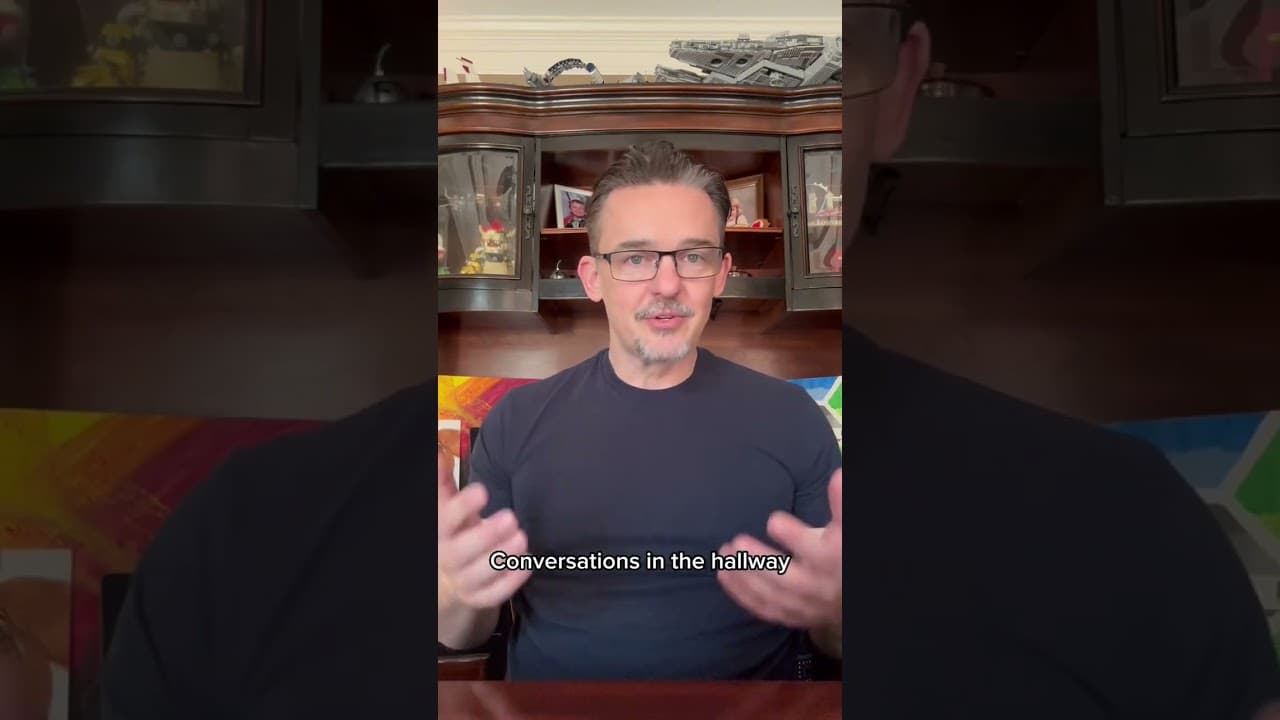
But most business decisions don’t work like that. The feedback is slow, the signals are messy, and a lot of context isn’t available, right? Conversations in the hallway, relationships between people, organizational politics, real-world constraints.
And when you’re making decisions like restructuring a team, or launching a new product, or entering a new market, you might not know for a year or more whether it was brilliant or a total mistake, or as is most often the case, somewhere in the middle.
So judgment’s not something you automatically move up into once AI does the work. It’s something you build. You test ideas, you get feedback, you challenge your assumptions, you pay attention to what actually happens. In other words, judgment isn’t something you have just because you’re human. It’s something you train.